
Combined treatment with CO2 laser and bipolar radiofrequency (DOT/RF therapy) provides a dual effect:
- higher treatment effectiveness due to the synergy of the two methods;
- more than 40% shorter recovery time.
Excessive melanin production may lead to pigmentation spots or lesions appearing on various areas of the face and body.
Pigmentation spots vary in size and shape, ranging from light to dark brown. They most commonly occur due to sun exposure and skin ageing, but may also be congenital or develop after inflammatory skin conditions. Over time, they tend to enlarge, become more pronounced and visible, and reduce the skin’s radiance.
Laser pigmentation removal is an effective and safe procedure that can eliminate many types of pigmentation spots.
Why is DOT/RF therapy safe, fast and effective?
Hundreds of thousands of laser procedures have been successfully performed worldwide. Clinical practice confirms that laser pigmentation removal, when performed by a qualified physician, is safe and effective.
Typically, only 1–2 procedures are required, performed at 4-week intervals. Compared to other depigmentation methods, results are achieved significantly faster.
Another advantage of DOT/RF therapy is stimulation of collagen production and new skin cell regeneration. As a result, the skin regains its natural radiance, appears smoother, and its moisture balance is restored.
Are there any side effects?
Skin reaction depends on the treated area. Usually, the skin becomes red, slightly swollen, and warm.
Immediately after the procedure, pigmentation spots may appear darker, but within 5–7 days they lighten, and within 2 weeks they may disappear completely, leaving a more even skin tone.
After the procedure, PRP (platelet-rich plasma) application is recommended. It shortens recovery time, reduces inflammation, and enhances the results of laser treatment. Growth factors in plasma stimulate new cell formation, replace fibrotic tissue with new dermal cells (fibroblasts), and help restore normal skin structure. PRP also has antimicrobial properties, reducing the risk of secondary infection.
IMPORTANT: At Primum Estetica, a test on the forearm skin is performed before the procedure and evaluated after 5 days. Based on the results, the physician decides whether the procedure is suitable.
How to prepare for the procedure?
During the initial consultation, the physician gathers relevant medical information and discusses treatment expectations.
Preparation is essential for optimal results.
General recommendations:
- avoid sun exposure and tanning for 4 weeks;
- avoid exfoliating treatments and use gentle cleansers for 4 weeks;
- avoid retinol products for 2 weeks;
- avoid hair removal procedures in the treatment area for 2 weeks;
- avoid antibiotics for 2 weeks;
- discontinue anticoagulants at least 3 days before the procedure (if medically possible).
Inform your doctor a few days before the procedure:
- about previous plastic or reconstructive surgeries;
- if you have had herpes;
- about any medications you are taking.
Skin must be healthy, without inflammation.
Is the procedure painful?
DOT/RF therapy is generally not painful and is usually performed without anaesthesia. In some cases, a numbing cream may be used.
Patients may feel a mild tingling sensation followed by a feeling similar to sunburn.
How many procedures are needed?
The number depends on the size, depth, and colour of pigmentation. Results are visible after the first session. Up to 5 procedures may be required for optimal results, with 4-week intervals between sessions.
How long does the procedure take?
Depending on the treated area, the procedure lasts 10–30 minutes. Face and neck treatment takes about 30 minutes, larger areas about 40 minutes.
Results strongly depend on patient compliance before and after the procedure. Sun protection is essential for at least one month before and after treatment.
Who is NOT suitable for DOT/RF therapy?
The procedure is not recommended for patients who:
- have a pacemaker or cardiac implant;
- have connective tissue disorders or skin pathologies;
- are pregnant or breastfeeding;
- have infectious diseases;
- have cancer or a history of skin cancer;
- have kidney or liver dysfunction;
- have severe heart conditions or arrhythmia;
- have metal implants or piercings in the treatment area;
- have autoimmune diseases or diabetes;
- have blood clotting disorders;
- have undergone organ transplantation;
- have deep brain stimulation devices;
- have haemorrhagic conditions;
- are prone to keloid scarring;
- have heavily tanned skin.
Results of DOT/RF pigmentation treatment
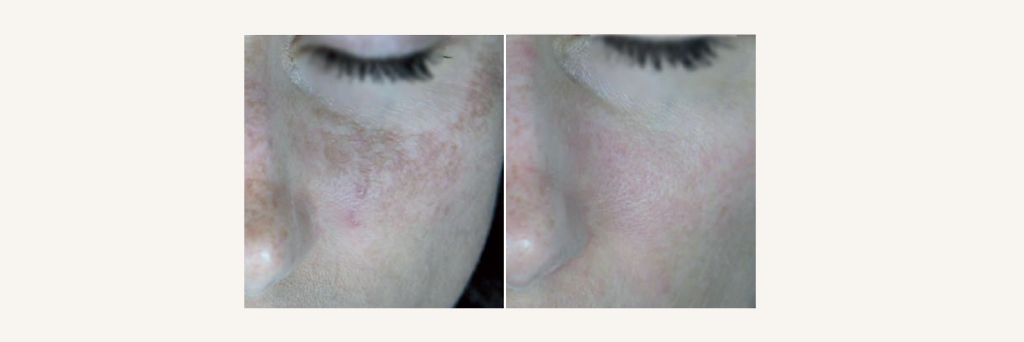
Treatment of dyschromia (pigmentation): before the procedure and 2 months after DOT/RF therapy