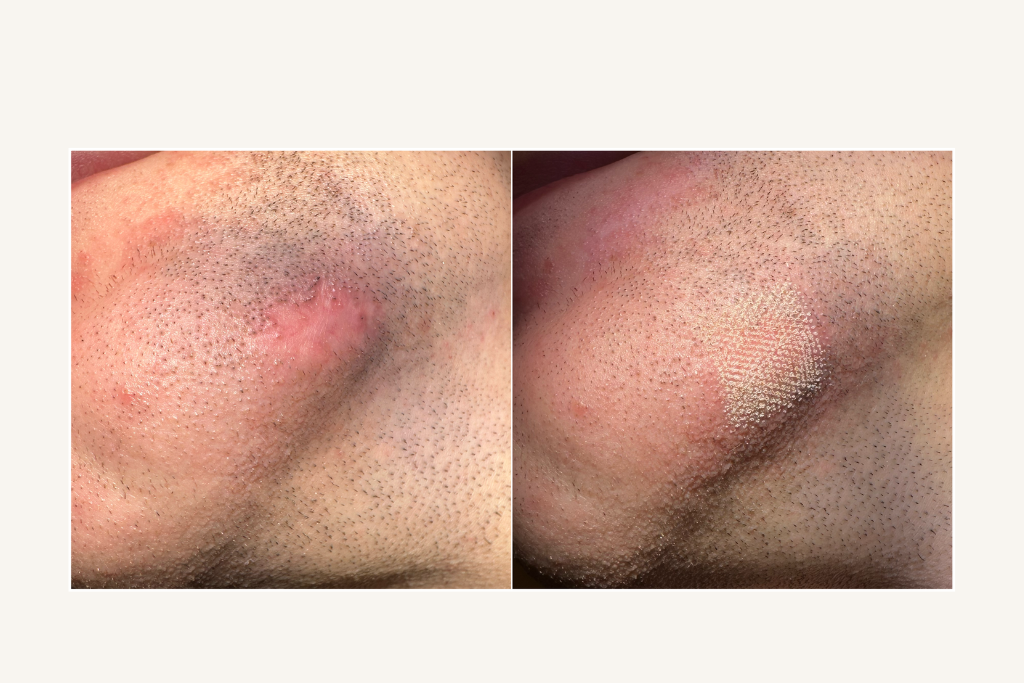
Combined treatment with CO2 laser and bipolar radiofrequency (DOT/RF therapy) provides a dual effect:
• greater treatment effectiveness due to the synergy of the two methods;
• more than 40 per cent shorter healing time.
Scars most often appear after the skin has healed following injury. Large and visible scars may cause emotional discomfort and reduce self-confidence. One of the most effective scar treatment methods is laser therapy. This is a non-invasive treatment method associated with minimal discomfort and visible results.
During the laser scar removal procedure, not the entire skin is treated, but only part of it using a fractional approach. The laser beam penetrates the selected skin layer and creates microscopic channels, forming micro-areas surrounded by unaffected tissue. Cells within these areas (fibroblasts) are activated, and the treated skin begins to regenerate. At the same time, controlled energy delivery stimulates natural collagen production and accelerates skin renewal.
This procedure effectively improves skin quality without surgery or injections, and results are often visible after a single session.
Laser scar removal is a safe and effective procedure.
What are the advantages of DOT/RF laser therapy?
The main advantages of this laser procedure are:
• results are visible after the first procedure;
• the treated skin regenerates during healing;
• multiple skin concerns can be addressed during a single procedure.
What skin problems can be treated with fractional DOT/RF laser therapy?
This laser procedure not only smooths various types of scars (acne, trauma, surgical, burn scars), but also:
• smooths fine, moderate and deep wrinkles;
• improves skin firmness;
• evens out skin tone and restores radiance;
• reduces stretch marks;
• minimises enlarged pores;
• removes pigmented lesions.
The effects of the procedure become noticeable after approximately one month.
How long does the DOT/RF laser scar removal procedure take?
The procedure takes 60–90 minutes, including preparation, treatment and post-procedure care.
The scar removal itself takes about 30 minutes.
Does the DOT/RF laser scar removal procedure have side effects?
Skin response depends on the treated area. Typically, redness, mild swelling and warmth may occur.
To support skin recovery, PRP (platelet-rich plasma) application is recommended. It shortens healing time, reduces inflammation and enhances treatment results. Growth factors stimulate new cell formation and support replacement of fibrotic tissue with healthy dermal cells (fibroblasts). PRP also has antimicrobial properties, reducing the risk of secondary infection.
During healing, scabs or blisters may form, and the skin may peel.
In rare cases, temporary pigmentation changes may occur. In very rare cases, scarring or skin fissures may develop.
IMPORTANT: At Primum Estetica, a test is performed prior to the procedure and evaluated after five days. Based on the results, the physician determines whether the procedure is appropriate.
How to prepare for the laser scar removal procedure?
During the initial consultation, the physician gathers relevant medical information and discusses treatment expectations.
The success of laser procedures depends greatly on proper preparation.
General recommendations:
• avoid UV exposure and tanning for 4 weeks;
• use gentle cleansers and avoid exfoliation for 4 weeks;
• avoid retinol-containing products for 2 weeks;
• avoid hair removal or laser hair removal procedures for 2 weeks;
• avoid antibiotics for 2 weeks;
• discontinue anticoagulants at least 3 days before the procedure.
Inform your doctor:
• if you have undergone plastic or reconstructive surgery;
• if you have a history of herpes;
• if you are taking any medication.
The skin must be healthy and free of inflammation before the procedure.
How many DOT/RF laser scar removal procedures are needed?
The number of procedures depends on individual goals and is discussed with the treating physician.
Are DOT/RF laser scar removal procedures painful?
To ensure comfort, a topical anaesthetic cream is applied before the procedure.
When can’t DOT/RF laser scar removal procedures be performed?
The procedure is not performed in patients who:
• have a pacemaker or cardiac implant;
• have connective tissue disorders or skin conditions;
• are pregnant or breastfeeding;
• have infectious diseases;
• have active malignancy or a history of skin cancer;
• have kidney or liver dysfunction;
• have severe cardiac conditions or arrhythmias;
• have metal implants or piercings in the treatment area;
• have autoimmune diseases or diabetes;
• have blood clotting disorders;
• have undergone organ transplantation;
• have deep brain stimulation systems;
• have haemorrhagic conditions;
• are prone to keloid scarring or abnormal wound healing;
• have heavily tanned skin.
How should the skin be cared for after DOT/RF laser scar removal procedures?
The physician provides detailed post-procedure care instructions.
General recommendations:
• avoid UV exposure for 4 weeks;
• avoid aggressive skincare products;
• follow medical recommendations.
The procedure is performed using the DEKA SmartXide DOT/RF CO2 laser with integrated radiofrequency. This combination is considered the gold standard because:
• skin irregularities are reduced and elasticity improves after one procedure;
• suitable for various face and body areas and different skin types;
• safe for sensitive areas (around the eyes, neck, décolleté);
• PSD technology ensures minimal thermal damage and faster recovery.
In the gallery, you can see before-and-after results of post-traumatic scar treatment performed by Dr A. Bartkevičiūtė.